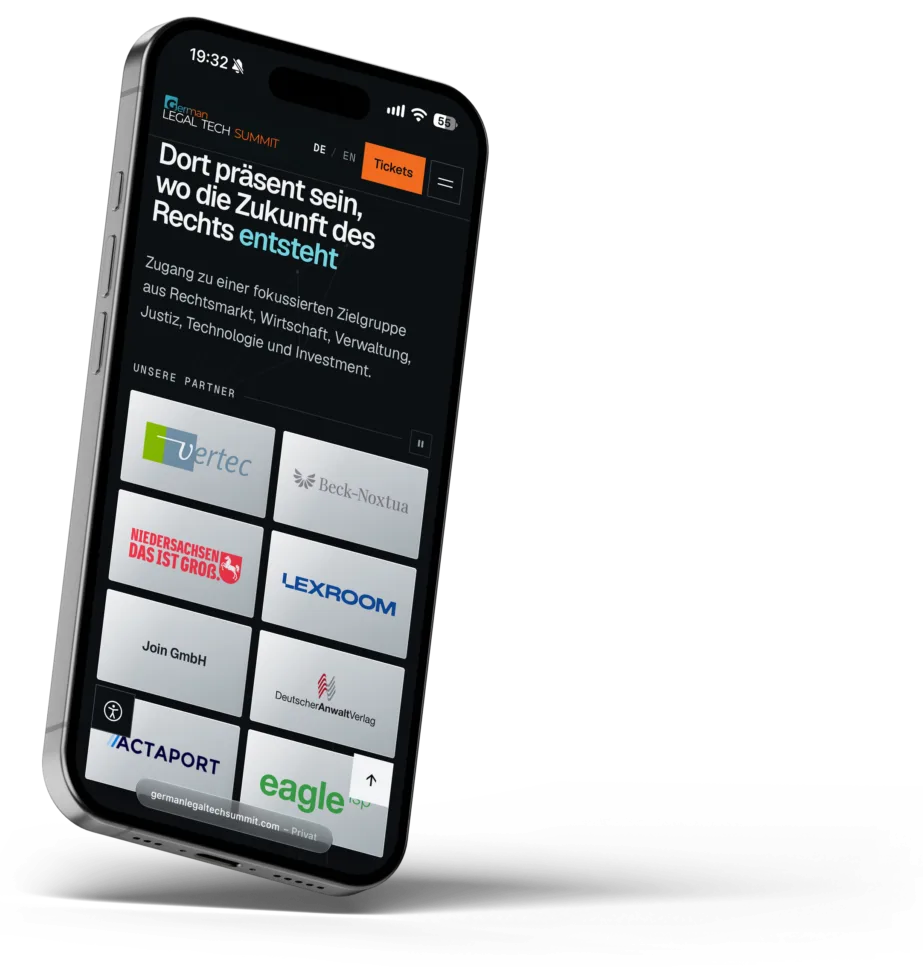
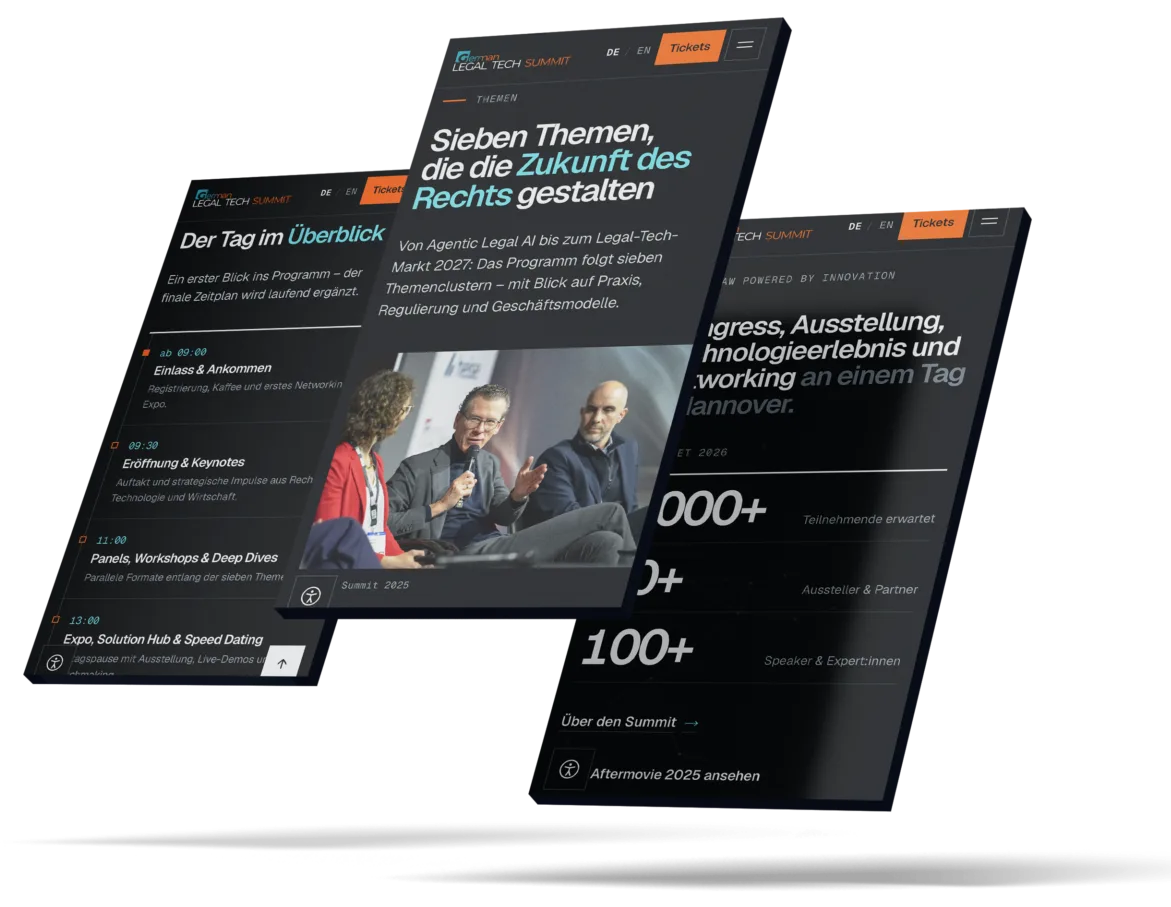
The German Legal Tech Summit is the congress festival for legal tech and AI in Hannover: one day on which law firms, in-house legal teams, the judiciary, public administration and vendors come together. For the fourth edition on 3 December 2026 at the HCC Hannover we rebuilt the website and the backend behind it as well. The programme, speakers, exhibitors and partners are maintained there and go online the moment they are released.
The 200 participants of the first year had become more than 800 by 2025. For 2026 the organiser expects over 1,000 guests, more than 100 speakers and over 60 exhibitors and partners. With every edition the programme grows, so does the number of profiles, and so does the pace at which content changes.
The previous website had no content management system, every piece of content was hard-coded. A new session, another speaker or an additional exhibitor meant a new job every time. That does not suit an event whose programme keeps filling up until shortly before the day.
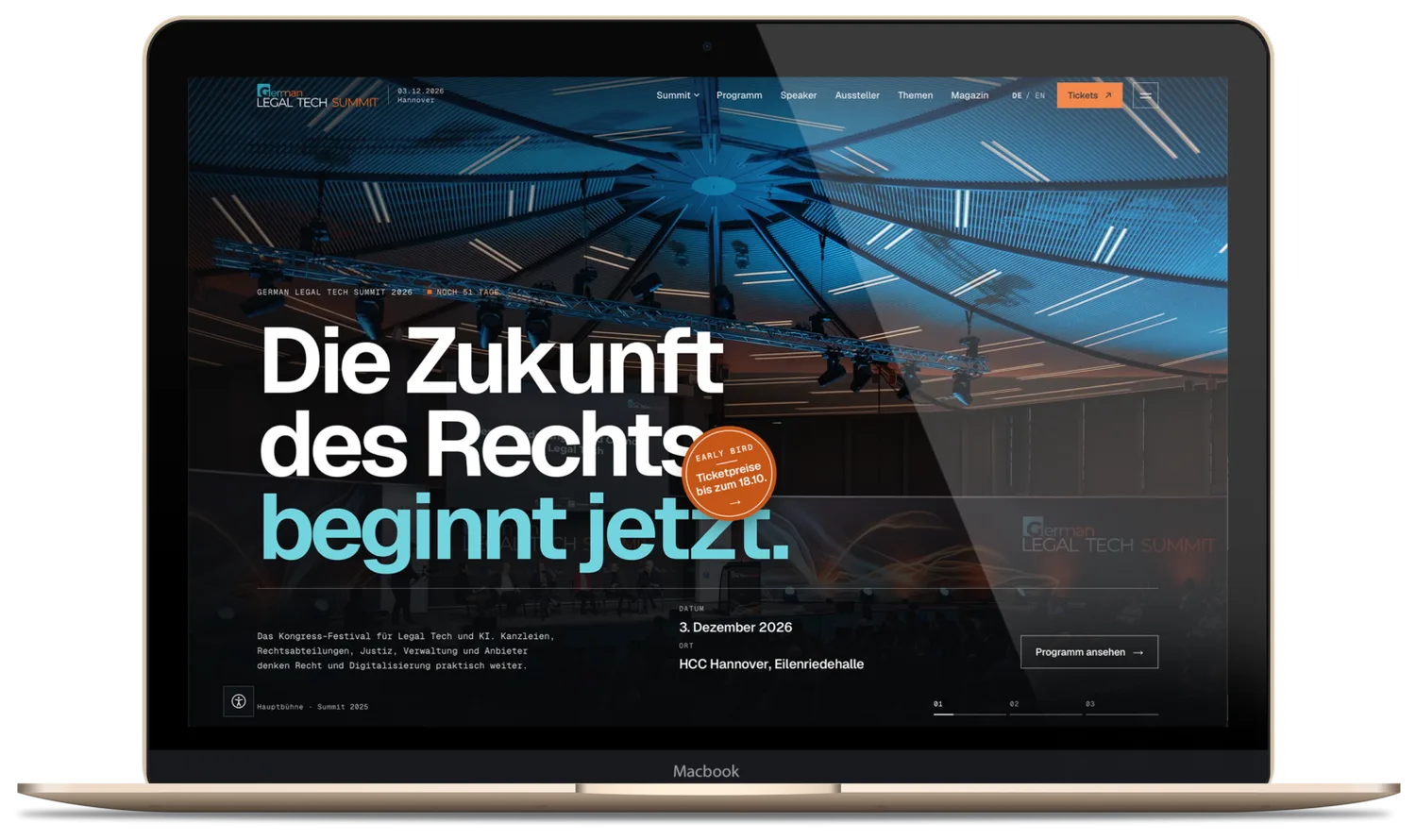
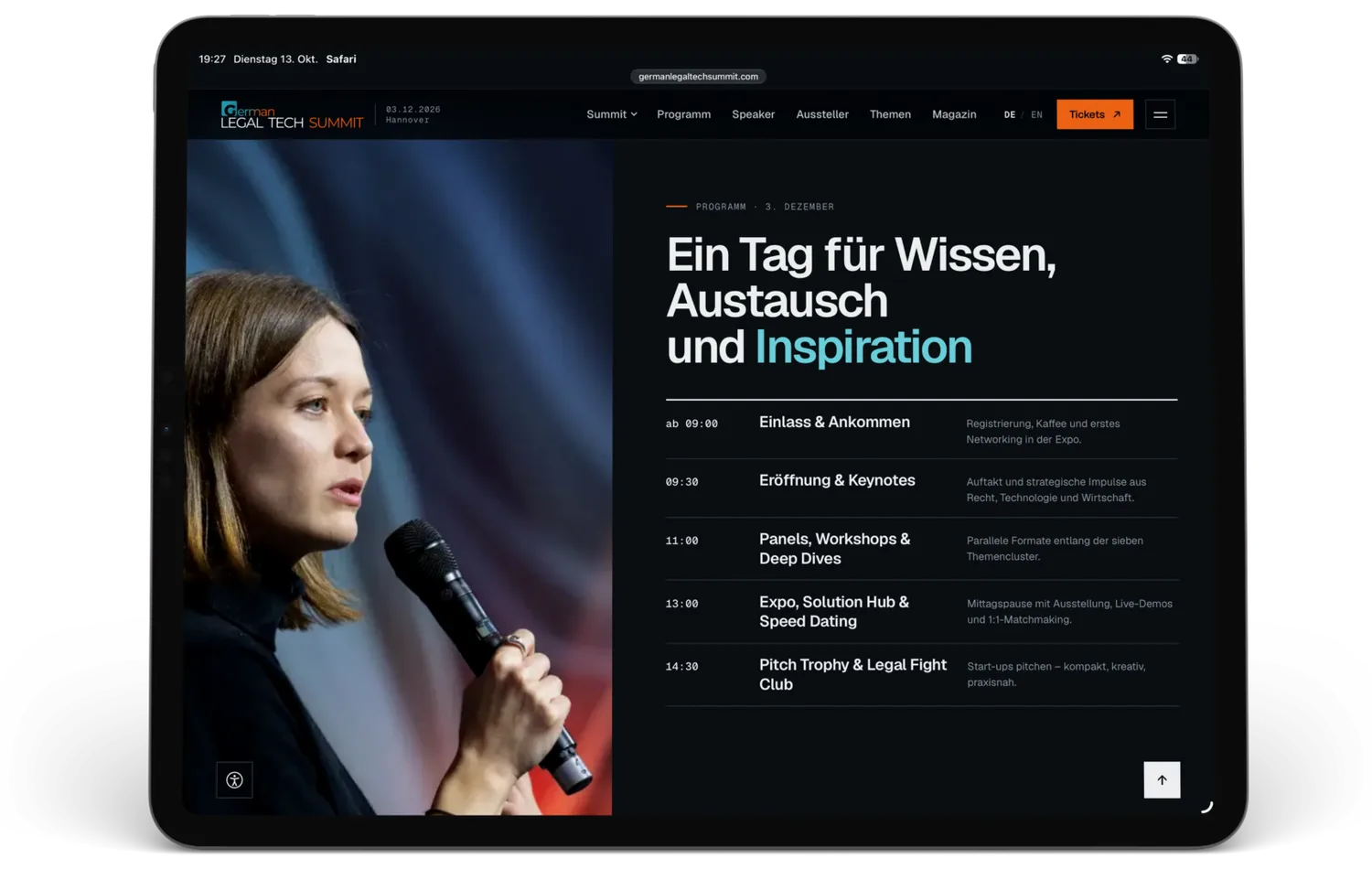
The logo and the turquoise and orange colours stayed, they belong to the brand. The typeface, the grid and the motion are new. The home page opens with a slider whose images blend into one another through a grid, and the line „Die Zukunft des Rechts beginnt jetzt.“, the future of law begins now, assembles itself character by character.
A fine neural network runs in the background, the key figures count up as you scroll, and the partner logos stand as a calm wall. Light, dark or automatically matched to the device: everyone chooses the colour scheme for themselves. The site looks like technology without getting loud.

A congress day with several stages only stays clear if everyone finds their own way through it. So the programme can be switched by stage and filtered by format, topic, audience, level and language. Every session has its own page with a description, the time and portraits of the speakers.
A star bookmarks a session. „My programme“ then holds the personal plan for the day, as a calendar file to take along or to print. If a session comes from an exhibitor, the page leads straight to their profile.
Speakers get their own profile with a portrait, their role and their sessions, alongside the advisory board and the hosts. Exhibitors are listed in the directory by partner tier, from the main partner down to the exhibitor, each company with its own profile page. The media partners too.
Anyone who wants to exhibit finds four packages with a comparison table under „Become a partner“. Start-ups and law firms apply through their own forms for the Start-up Pitch Trophy and the Law Firm Pitch Trophy. And because profiles get shared, every speaker and every exhibitor automatically gets a preview image of their own for LinkedIn and the like.

Behind the website there is a backend we built, which the Summit shares with the German Legal Tech Hub. Speakers, exhibitors, partners and media partners each have a record there with a switch for the website. The organiser maintains the programme, the magazine, the FAQ and the team in the same place.
Whatever is released is online within seconds. Nobody waits for an agency, nobody copies text from one system into another. The English versions are produced automatically by AI along the way and can be refined by hand.
The way back is just as short. Contact enquiries, partner enquiries and applications for the two pitch trophies arrive as a case in the backend's CRM and as an email in the inbox as well. No enquiry gets stuck in a single inbox.

On the day itself the programme and the exhibitor list are read mostly on a phone, between two sessions and on the way through the hall. So every page rearranges itself on a smartphone without losing anything. A button on every page adjusts the presentation, and anyone who has asked their device for less motion gets less motion here too.
On top of that the site is sparing with data. Fonts sit on its own server rather than with Google, the map and videos only load after a click, the newsletter uses a confirmed sign-up, and audience measurement works without cookies.
Exhibitors get a web app of their own in the Summit's design. They sign in with a code sent by email, with no password at all, and find five areas there: Today, Meetings, Network, Team and Profile.
In the profile they maintain their presence, their contacts at the stand with a photo and the times at which they are available for meetings. Booked meetings arrive directly in the app, sorted by contact. Through the network exhibitors get in touch with one another, and if their package includes a talk, they enter the speakers for it themselves.
The tickets are there too. Exhibitors see the free tickets included in their package, book more for their own team or for guests and pass them on by email or WhatsApp. For the organiser that means fewer emails back and forth, less retyping, and every profile is as current as the exhibitor keeps it.
Every ticket appears in a wallet-style design: the Summit logo, name, ticket type, role, company and partner tier, with the QR code in the middle. Speakers find it in their speaker profile, exhibitors and partners in their web app, and it arrives by email as well.
On the day nobody has to dig through their inbox for an attachment. Open your profile and your ticket is right there.
The Summit also speaks to an international audience. So the whole site is available in English too, with its own English URLs, clean language references and a sitemap covering both languages. That is 106 pages in each language.
For search engines the site describes the event with structured data, including venue, date and organiser. An llms.txt sums up the essentials for AI assistants, and new pages are actively reported to Google and Bing instead of waiting for the crawler's next visit.
The old website sat on an agency's server. First we secured what was there and rebuilt every page one to one, and only then came the new design. That way no content was lost in the switch.
We restored the reviews of 2023 to 2025 from the web archive. 102 URLs from earlier years redirect to the matching new page, so links and search results keep working. Since 30 September 2026 the site has been running on a server of the Summit GmbH's own in Germany, with the old server kept as a fallback for the first two weeks.
Three more parts are finished and go online at the right moment before the congress:
The programme keeps filling up with sessions until 3 December. Nothing more has to be built on the website for that, every new session is a release in the backend.
In a free first conversation we look at how you work today and tell you what can be automated. No obligation, no sales pressure.