Immobilien am Zoo has been selling and letting flats and houses in Hannover since 1967. For the agency run by Helga Müller-Offenhausen we rebuilt the entire website and added a bespoke backend where properties, brochures, enquiries, articles and the newsletter all come together. No page builder, no third-party content system, all of it built from scratch.
An agency that has served the same city since 1967 has something no competitor can recreate: local knowledge across generations, and clients who come back. Online, little of that was visible. That was the brief, not a new look, but a presence that shows this experience.
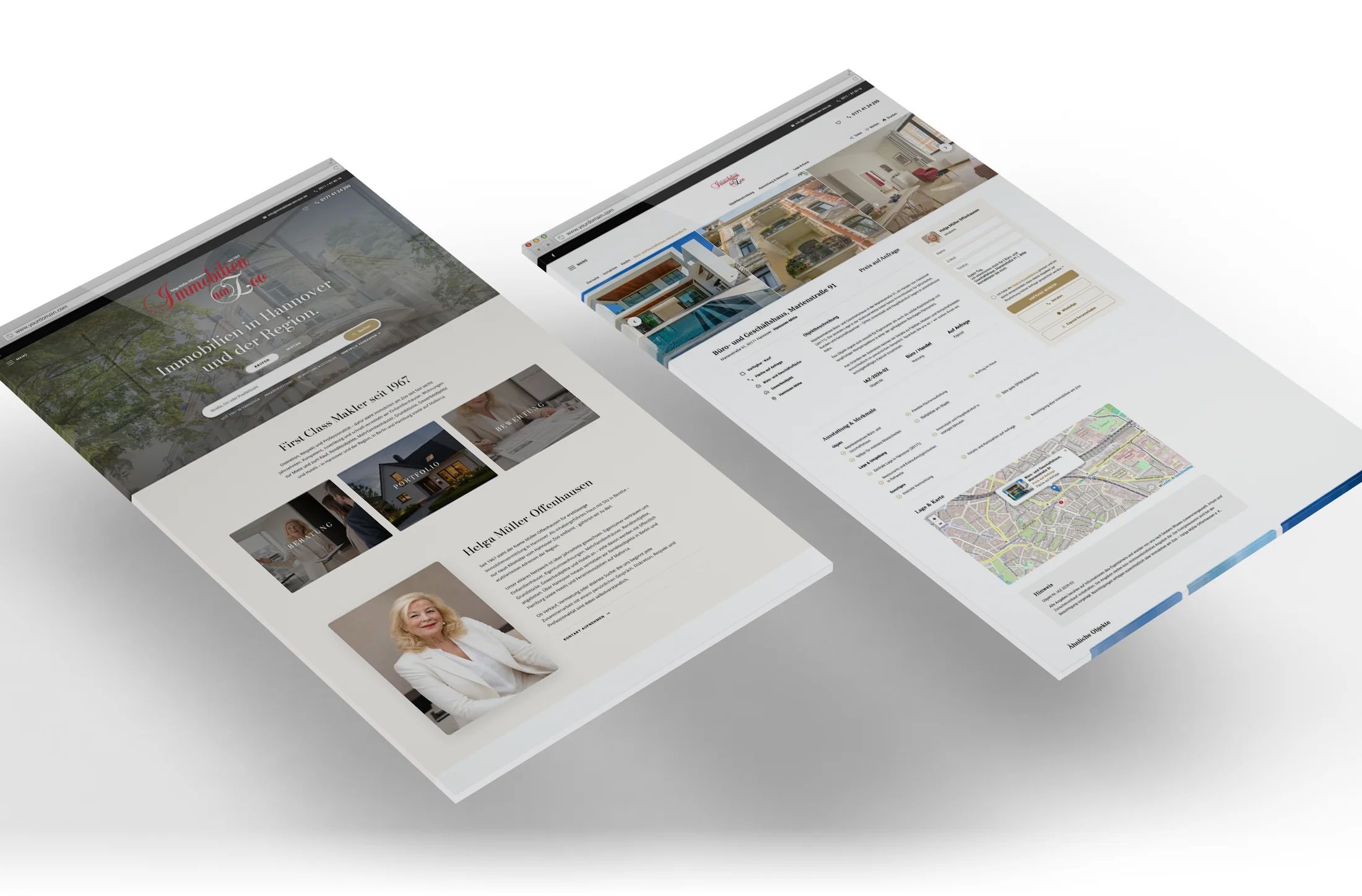
The design therefore stays calm. Gold as the only accent, a classical serif for the headings, generous white space and large photographs of real properties. The header floats transparently over the cover image, with the logo and its line „seit 1967“, meaning since 1967, sitting bright above it. No gradients, no effects, no tiles fighting for attention.
Anyone looking for a property is making one of the biggest decisions of their life. A website that gets loud about it loses.
The search does not sit on a subpage, it sits in the cover image of the home page: buy or rent, location, property type, go. Anyone wanting to narrow things down finds free text, district, property type, availability and five sort orders in the overview, from the newest listing to the price per square metre.
Many people, though, are not looking for a property type at all, they are looking for an area. So the districts are a way in of their own, each with a real photograph and the number of available properties, with a filter that counts along as you type. Zooviertel, List, Kirchrode, Südstadt, Mitte, Kleefeld. One click, and the overview shows that district alone.
If a property appeals, the heart on the card is enough. The shortlist needs no account and no sign-up, it lives in the visitor's browser alone, and the counter in the header shows how many properties are on it. Anyone coming back finds their selection waiting, without ever having left any data behind.
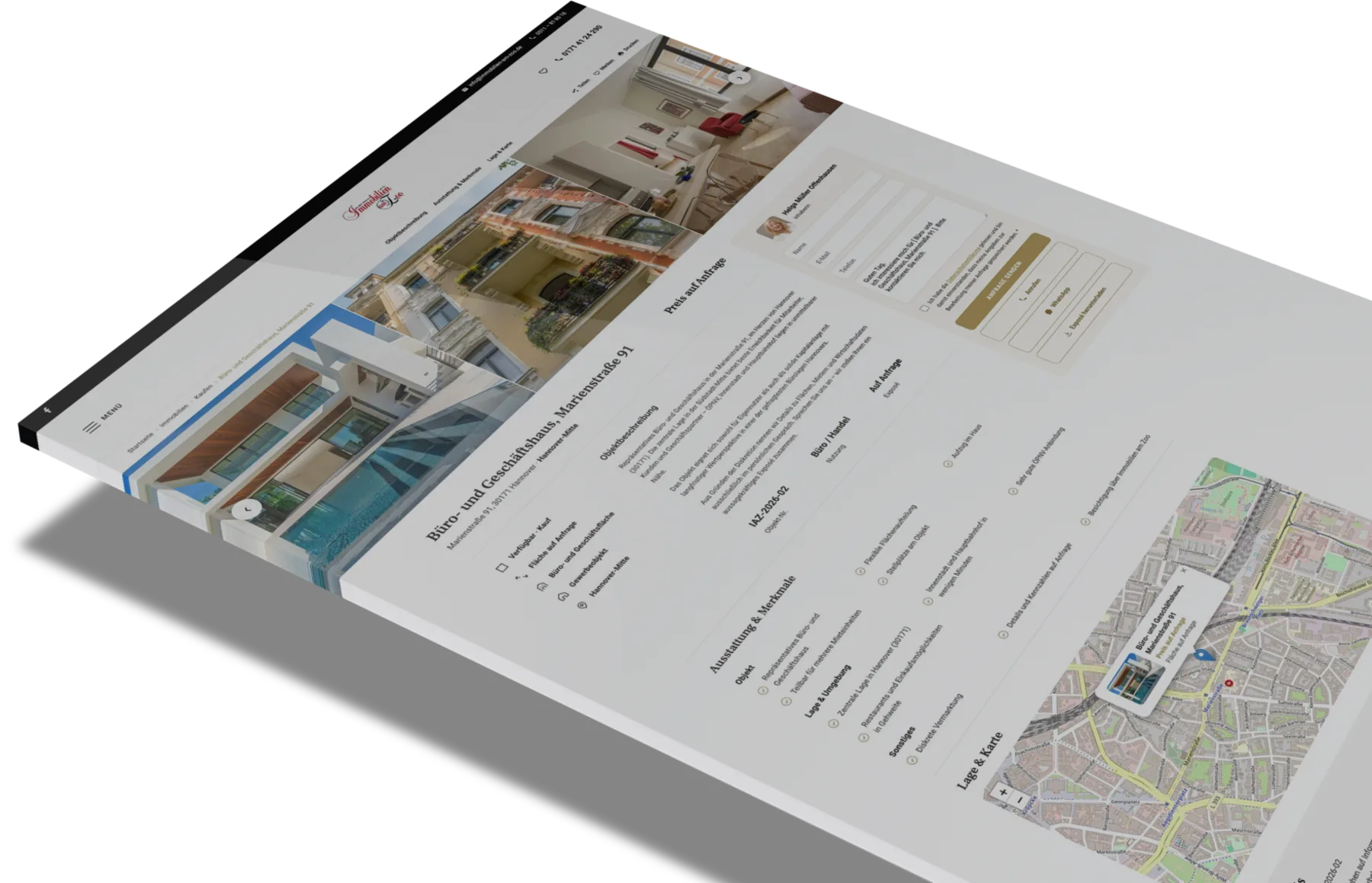
The property page shows everything in one place: an image gallery with a lightbox, the key figures, the description, the fittings, the location on the map, the agent responsible with a photograph, and the enquiry form right beside it. Similar properties sit below, so the visit does not end when one listing turns out not to fit.
Every property runs under a readable address rather than a running number. That address is fixed on the first save and stays put, even when things are reordered or deleted in the backend. Before, the same address could suddenly point at a different house after a change. A shared link now stays valid, and Google does not lose the page.
Property sites live on photographs, and photographs are heavy. Every image is therefore served automatically in four widths and in the modern WebP format, with fixed dimensions against jumping layouts and loading only once the visitor scrolls. On the home page 10.66 megabytes became 3.34, with no loss of impact.
In an agent's working day nothing costs as much time as the property brochure. A listing goes up, and then the second job starts: typing the same figures into a layout file again, placing photographs, exporting, sending. Here that step disappears entirely.
Anyone listing a property already has the brochure. It is produced fresh on every download from the data already entered: a cover with the lead photograph, a dark band of text and the logo, then the description, the fittings, the image gallery and the contact with a direct line. Interested buyers download it from the property page, the office produces it in the backend straight from the list.
The decisive point is not convenience, it is reliability. There is no stored version that can go out of date. If the price changes, the brochure changes in the same moment. A document with an old price simply cannot be in circulation any more.

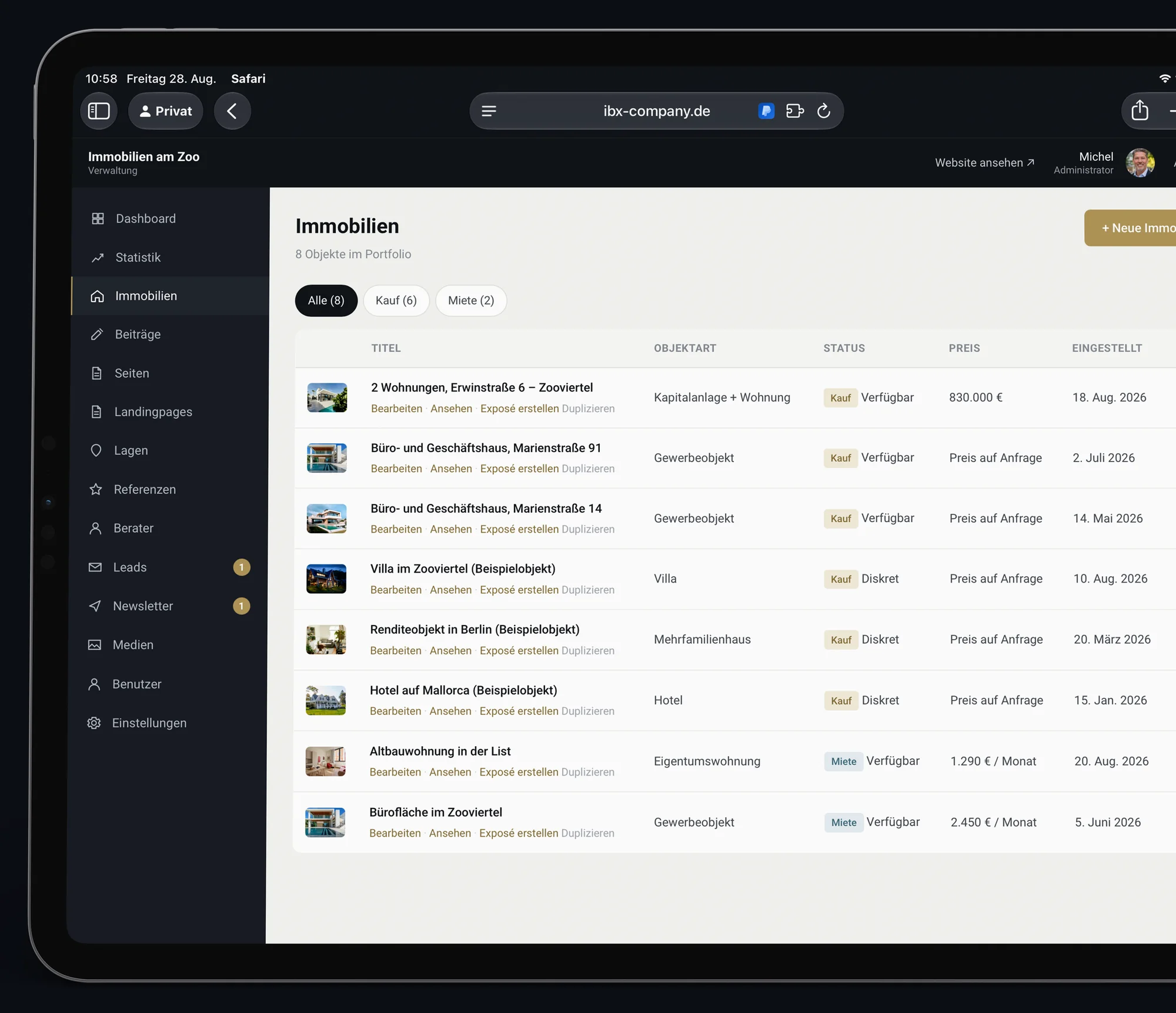
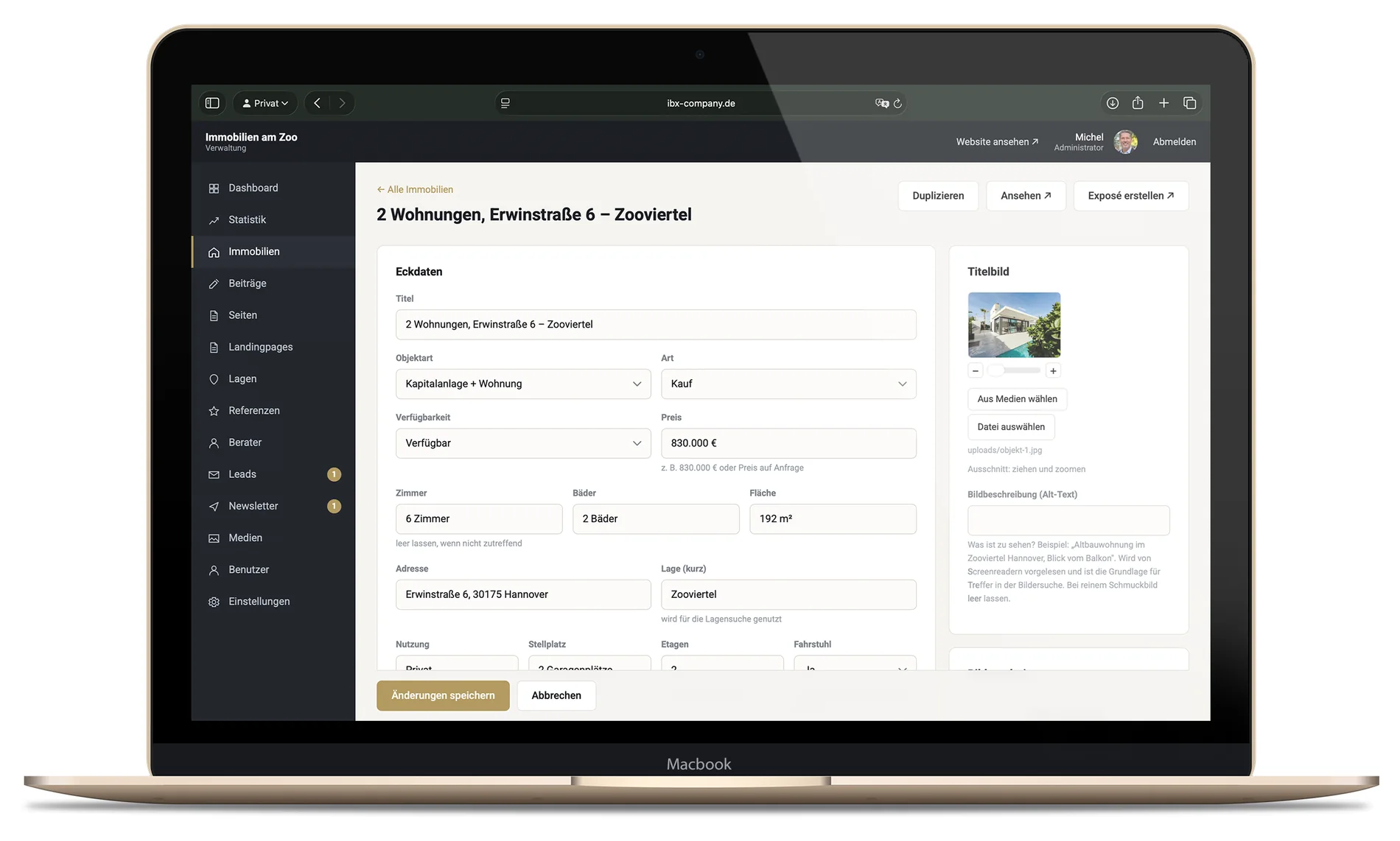
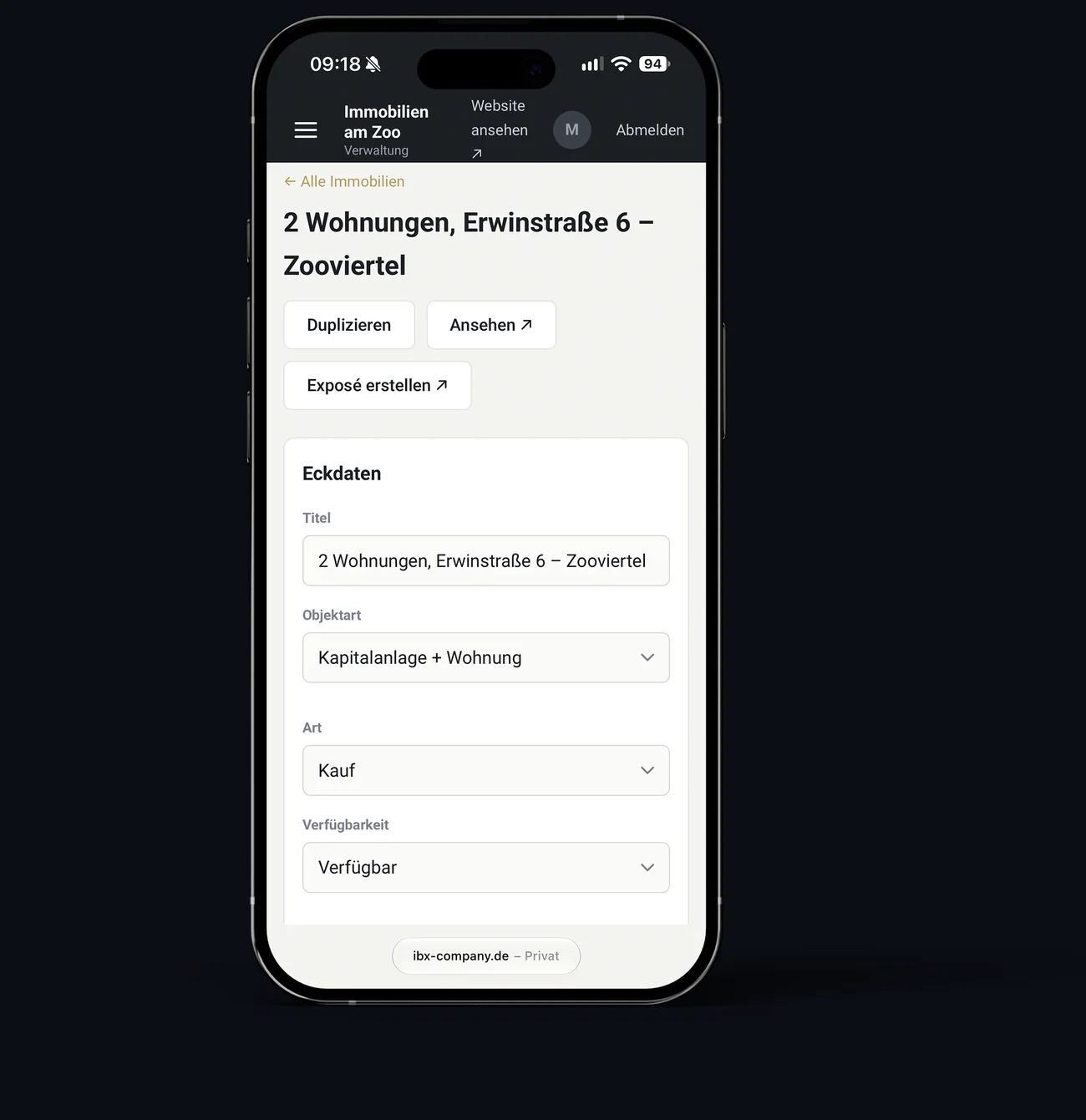
Behind the website there is no WordPress and no third-party content system, but a backend we built for this office. The menu is labelled in plain language: properties, articles, pages, districts, agents, leads, media, users, settings. Nobody working here has to learn jargon first.
On signing in, the dashboard shows what is due: visits today and this month, open enquiries, the properties listed most recently, quick links. A property can be duplicated when the next one is in the same building. Agents are assigned per property and appear automatically on the property page, in the brochure and in the team. Two roles separate the rights: administrators may do everything, editors maintain content without access to users and settings.
Images are not only uploaded, they are cropped as well. Dragging moves the frame, a slider or the mouse wheel zooms, and the window has the shape the image will later appear in. The original stays untouched, the cropped version is created alongside it. That way a tile looks right without anyone having to open an image editor.
The visitor figures stay in house too. The statistics show the trend by year, month and day, devices, origin on a world map, referrers and, separately, which AI services are fetching the site. Counting happens without IP addresses, through a short key that changes daily. No analytics service, no advertising script, nothing passed on to third parties.

A new listing is only worth something once someone sees it. Usually that means writing the text again, finding an image, posting to each network separately, then setting up the newsletter in the next tool. Four tools, four logins, the same data four times.
Here there is a button on every property and every article. One click, and the post goes out to the office's social media channels with the lead photograph, the key figures and a link. A second click sends the same property as a newsletter to the recipients who signed up for it and confirmed their sign-up.
Both run in the same system the property already sits in. Nothing is copied, nothing is maintained twice, and a listing cannot be current in one channel and out of date in another.
Half the business is not in the listings, it is with the owners who are still thinking about it. Their first question is always the same: what is my property worth? There is a page of its own for that, with a form for the valuation request and the answers people need before they send it: how a valuation works, what it costs, which documents to bring to the appointment.
Alongside it sit pages for sellers, such as selling a property, selling a house in Hannover, selling a flat in Hannover, and pages for individual towns. They can be created freely in the backend, with sections, lists, a source note and an automatic list of the properties in that district.
Every enquiry from the valuation page, from a property, from the gallery or from the contact form becomes a case in the backend with a timestamp, the subject, the source, the property and a status, open or done, plus an export as a table. Nothing sits in one person's inbox, nothing gets lost between two holidays. An invisible field in every form keeps bots out, and consent to the privacy notice belongs to all of them.
A property search starts on Google, but more and more often on ChatGPT or Perplexity as well. Both need the same foundation and a different finish. The foundation is in place: readable addresses, canonicals, a sitemap, visible breadcrumbs, individual page titles and descriptions for every property, article and page, plus one switch that releases the whole site at launch.
For Google a connected data graph describes what is on each page: the agency as a local business with address, telephone and opening hours, every listing as a property entry, every guidance article, the questions and answers, the services and the places. The graph reads the opening hours from the same lines that appear on the contact page, so display and markup can never drift apart. Deliberately absent are self-awarded star ratings, which can block rich results for an entire domain.
For answer engines something else counts, namely being quotable. The AI crawlers are explicitly allowed in robots.txt, which is a decision rather than a default. The question section has grown to 25 questions in five groups, each question with a heading of its own. And the texts follow fixed rules: answer the question in the first paragraph, back every figure with a source and a date, write the company name instead of „we“ wherever a passage might be quoted, and put Hannover into the statement rather than only into the page title. A passage torn out of its context has to hold up on its own.
In the end the whole project can be measured against one process. A property comes in, it is entered once, and everything else follows from that.
That is the difference between a website and a tool. One has to be maintained, the other takes work off your hands.